Stephen Hartzog
Responsible for all programming, design and conceptual development, unless otherwise noted.Becoming Digital
An Idiosyncratic History in an Evolving medium
Eschewing grand theories of distributed digital media.Allowing concepts to arise out of experiences in cultural production.
“Learning would be exceedingly laborious, not to mention hazardous, if people had to rely solely on the effects of their own actions to inform them what to do. Fortunately, most human behavior is learned observationally through modeling: from observing others one forms an idea of how new behaviors are performed, and on later occasions this coded information serves as a guide for action.”
— Albert Bandura, Social Learning Theory
-
Pre-Digital
-
Pre-Critical Tendencies
- Love Drawing
- “Good at Math” (but, no love for it)
-
Becoming Critical
- St. John's College, Santa Fe NM
Reading and discussing “The Great Books of the Western World.”
Learning to Love Math as a humane activity.
Discovering Science in a human voice.
- St. John's College, Santa Fe NM
-
Concern for Science
- Environmental Science Education
- Los Alamos National Laboratories
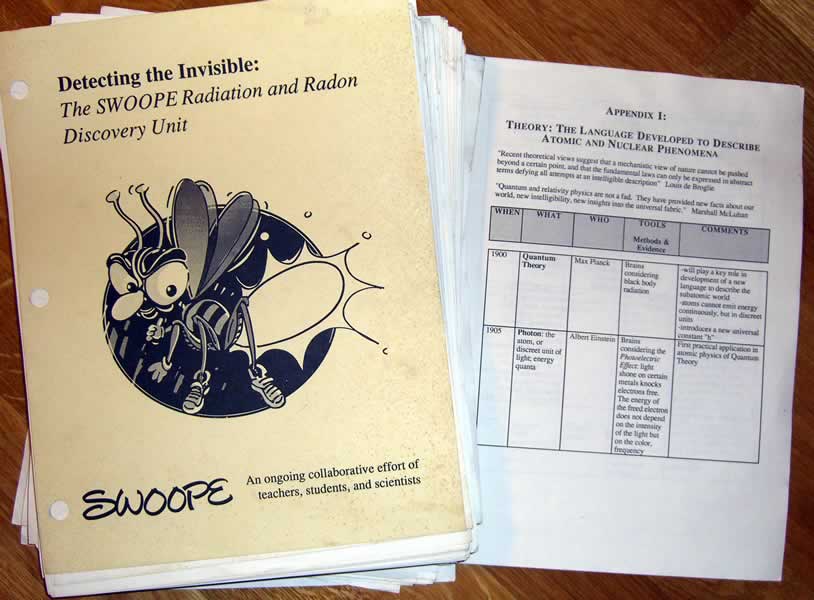
Students Watching Over Our Planet Earth (SWOOPE Project)
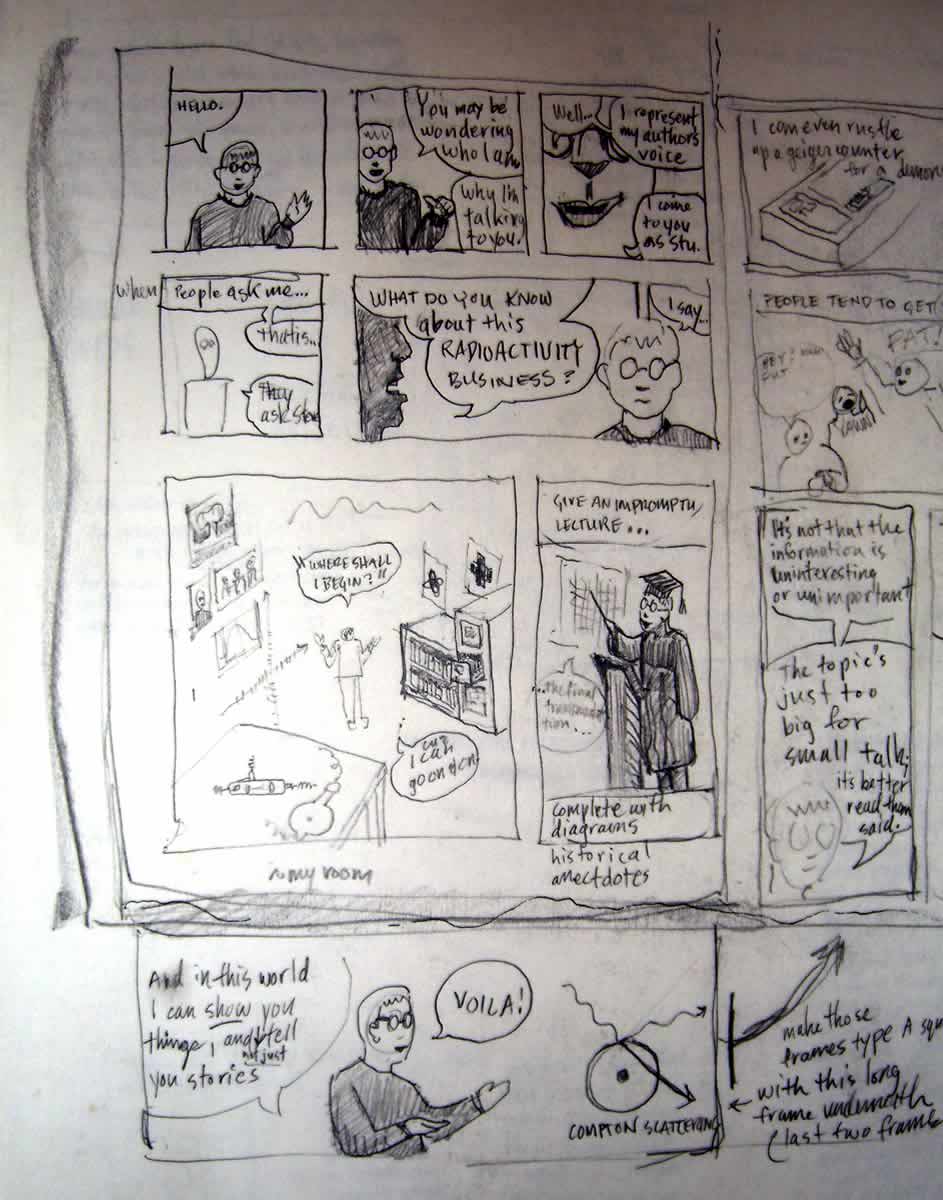
Immersion in scientific culture, researching science and history for the purposes of cultural transmission.
Students building national databases of environmental measurements. “Hands-On” science uses math as a means to understanding your world
(vs. math as an end-in-itself).
- Los Alamos National Laboratories
- Expanding Interests
- Environmental Science Education
-
-
Becoming Digital — Critical HyperMedia
Desire: to learn the new writing, the language of multimedia.
· Content driven development = technical experiment + critical content
· Web media cuts across all disciplines.
SFSU: wide ranging exploration of University offerings via Special Major.- Nuke Links
HTML = HyperLinking Enthusiasm
www.research.nukes
It's TEXT! HTML is human readable! No fancy software required; low-res, DIY media. The BROWSER (“client”), my new home, my favorite medium. - As If
HTML/Hypermedia = Text + Image (like comix)
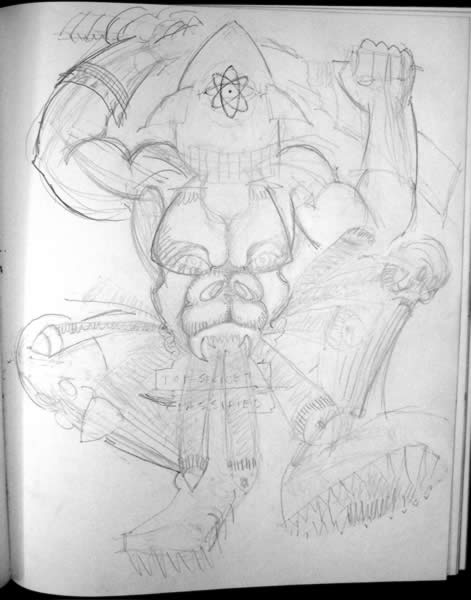
Interrogating the imagination of Science/Technology, discerning similarities between nukes and general hopes about exotic technologies. - Truths
JavaScript 1.0 = Events trigger image replacement
Dynamic text: physically interactive nonlinear reading.
Teacher: brother Jon; in an evolving medium, the amateurs are the experts. Reviewer: Anne Burdick, interested in design + writing.
- Nuclear Rocket to the Stars
JavaScript = Time-based image replacement + random location
Imagination meets scientific aspiration, meets the cold, hard facts of nukes and other mundane realities in space travel. - Messages from Space
JavaScript = random interactive image replacement + random location
The medium is the message in the search for extraterrestrial intelligence.
Critique of Dr. Frank Drake’s attempt to communicate with aliens via radiation broadcast into space. - The Real Me
Multimedia = time-based interactivity
The social construction of reality in the age of mass consumption. - Alien Personality Test
Multimedia = recording & displaying data created by user interaction;
random sounds + colors.
Plays on the mysterious intelligence behind the surfaces of machines and personality tests. Did you know you were being watched?
What's random? What's arbitrary? What starts as arbitrary relation becomes historically determined.
- Back Talk
Multimedia = nonlinear interactive video
“We went back to Chernobyl ...”
Critique of documentary conventions and of the uses scientific expertise.
New, interactive multimedia critiques old “new” media (linear, unilateral) by providing textual context and some play.
- Museum of Atomic perMutation
HTML = content + reference
M.A.p. collects and constructs stories from across the cultural spectrum about the power of radiation to alter bodies, searching the semiosphere online for information about the effects of ionizing radiation.
- Social Art Tactics
A survey of creative social practices. Participation required. (still)
Co-taught w/ Max Kelley. - Nukes.org
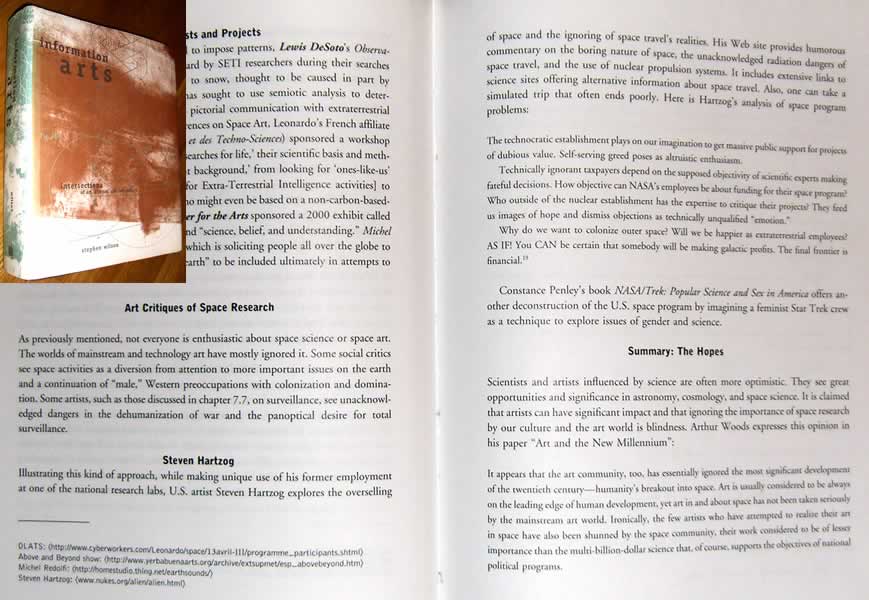
“I’ll use the term NUKES precisely for its lack of definition, in order to evoke, in a single word, a constellation of affects --- science, politics, business, propoganda ...”
Steve Wilson’s Information Arts: intersections of art, science and technology
- Nuke Links
-
Work in the Digital Field
In this rapidly evolving media, work is a means to continuous learning.- George LeGrady: spinning wheel simulation
First paid work in interactive multimedia, with former professor.
Teacher becomes colleague.
“George Legrady ... Professor, Media Arts & Technology graduate program, Department of Art, UCSB. Co-principal in the National Science Foundation IGERT Interactive Multimedia Research Program.” - Quokka Sports, Inc., lead designer
Daily digital storytelling with text and image, fast paced creative production
... becoming “designer.” - Post Tool Design = David Karam
Learning as work, the only way in an evolving medium.
Languages: XML + XSLt; Flash 4 ActionScript; CSS++; JavaScript++
“He uses programming to solve visual problems.”
- Gigi Obrecht, co-principal - etc.
- George LeGrady: spinning wheel simulation
-
Teaching = Practice + Theory
As work, with it's instrumental focus, grows bigger, teaching allows for continuing concentration on broader social context.-
Community Centers
HTML + Cascading Style Sheets (CSS); Multimedia authoring in MM Director- Artists’ Television Access
- Bay Area Video Coalition
- Media Alliance
-
Undergraduate Studios
- Advanced Digital Studio 4 : CCA.design+media
- Flash 5 ActionScript for Artists : Stanford University Digital Art Center
- Math + Media (with Barney Haynes) [more] : CCA.new_media
- Flash™ Art: Critical Interactive Multimedia : SFSU.cia
-
Graduate Courses
- The Digital (with Andy Cox) : CCA.seminar
From the Everyday to Political Economy, Art World to Deep Theory. - Digital Objects (with David Karam) : CCA.studio
Conceptual approach to Object-Oriented Programming. - Thesis Advising : CCA.research
Topics ranging from Social Software to Uncanny Objects/Robotic Sculpture.
“Thanks for the rigorous critique of my paper. Amazingly enough, out of five readers, you were the first to challenge any of my logic. Of course part of me hoped to get away with the stuff that you called me on, but it's a relief to finally get a thorough and knowledgeable reader. Thanks.”
- The Digital (with Andy Cox) : CCA.seminar
-
Some Materials Made
Pedagogic analysis and synthesis as means of research & development.- Reference Materials
- Demonstrations
- Flash Button Events { detectable events
- Mouse History { store moves, discrete
- Mouse Energy { store moves, continuous
- Mouse Move { analyze motion into angle, distance, time ... display data
- Mouse Move: Actual v. Potential { a small synthesis
- Mouse Move Massive Sine Series { water simulation; a work spin-off
-
-
Research & Development
Experiments in color, form, sound.
Experiments in interface.
Experiments in code structure.
- Vertext
Dynamically draw and manipulate vector letter forms. Tool for exploring parameters displayed as properties.Object Oriented Programming (OOP), my first
An “object” is like a Platonic form, a template or archetype from which the phenomenal, perceived thing is derived. Each letter is an “instance” of an object. (“objective” code; “subjective” simulation) - Stochastic Sound Machine
Analytic + Imaginative interfaces.
Interface becomes performative and demonstrative.
A visualization of sound object properties (aesthetic correspondence).
Discovery process: randomness as a means to explore “infinite” possibilities.
— see: Sound Object Demonstration
- Sound Investigation Sequence
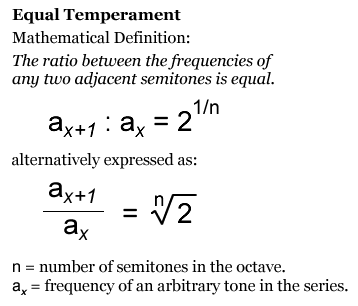
- Equal Temperaments [ image ]
MAX/MSP/Jitter
Sound generating exploration of harmony.
Sonically demonstrates the mathematical principle of equal temperaments.
Facilitates forming intuitions about the contours of a temperament. - Intercalate
“Intercalate: to insert between or among existing elements or layers.”
Drawing as setting up a potential field.
Converts gesture into a temporary “objective” reality.
Semi-random drawing + semi-random sounds (tones within a “key”).
Sounds generated with Equal Temperaments. - Circle of Fifths
Space for exploring sound sequences.
Experimental interface for exploring simple melody and harmony.
Tool for investigating tonal possibilities of the Western Chromatic Scale.
Sounds generated with Equal Temperaments.
An instrument I can play!
- Equal Temperaments [ image ]
- Geometric Color Combo
- Polygon
Technical: exploring dynamic symmetric drawing with vectors in Flash
(drawing by numbers!). Algorithmic visual property control.
— see: Color Object Demonstration - Qix
JAVA for cellphones
3D series of triangles modulating in three dimensions, randomly moving, scaling, shading, and detecting collisions with boundaries and with the player.
- Polygon
- OmniViewer Slideshow | xml
eXtensible Markup Language (XML) = external document describes content
Social need drives technical development.
see: mom's photo viewer widget + xml - MonkeyTypewriter (sic)
Obsessive-Compulsive Object-Oriented Programming
In the “flow,” i.e. “the state of total immersion in a task that is challenging yet closely matched with one's abilities.” (Mihaly Csikzentmihalyi, correlated with “contentment.”)
“Looking At vs. Looking Through”
— Richard Lanham, The Electronic Word
- Vertext
-
Digital Work: Collaboration + Interpretation
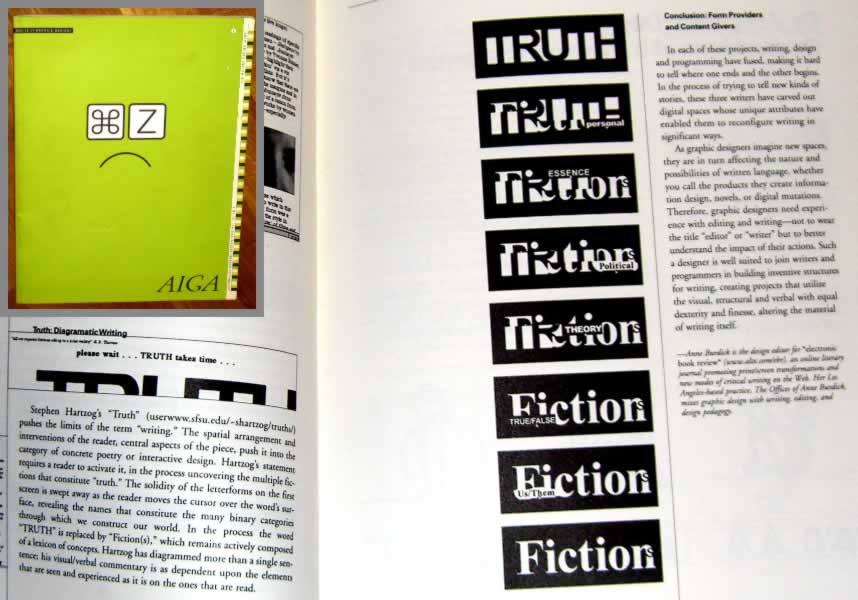
- Anne Burdick
- electronic book review
Client-side: JavaScript = Create & Destroy HTML Elements
Server-side: XSLtransforms XML into HTML page
THE POWER OF JAVASCRIPT : What Text can do in a Browser, today.
Everything element starts off as variables in the browser. The search pages, (and most parts of the other pages) are dynamically constructed, including html, css, and js event handlers. [process]
- Austrian Academy Corpus?
“AJAX” (Asynchronous JavaScript And XML)
“SPA” (Single Page Application)
Web application design for an electronic database of 19th- and 20th-century Austrian texts for the Austrian Academy of Sciences“Your p.s. question just brought up the BEST argument for dynamic generation.... ! The contents representation could be reconfigured on the fly, prioritizing DATE, MASS (number of pages, number of contributors...), etc.... Okay. Now I've got you hooked. ”
— Anne, email to me
- electronic book review
-
Carnegie Hall Presents Benjamin Britten’s
Medium specific : linear narrative + interactive exploration
“Young Person’s Guide to the Orchestra”
Expands Benjamin Britten's didactic endeavor into www distributed multimedia (in a time of funding shortages for arts in schools).
Multiple ways into each “object”/instrument.“You guys know there's nothing else remotely like this on the web, right?
You do KNOW that!?!?”
— Colin Morris, managing partner, Rolling Orange, Inc.,
- Anne Burdick
-
Nukes Today
Nuke History Outline | Annotated | xml
Authoring as setting up a potential field.
- Multiple Views of Data
XML + XSLt = Arbritrary Text Output (HTML)
Single data structure in XML can be tranformed by various XSLt documents for variety of displays. Ultimately, tagging/semantics could allow reorganization via user interaction. - Multiple Perspectives
Texts and Images brought together through search engines; offerings for you to pursue under your desire, construct your arguments, stories. Images, especially, show the cultural circulation of terms, e.g., see “cosmic rays.”
- Multiple Views of Data
-
The Future
Olivia + Tim + Me = Biological Modelling
Multiple Views: more/other/better/different metaphors.- Olivia : Internet based Literature survey, re: “unfolded protein response.”
- Tim : Modelling chemical dyanmics, beyond static “ball and stick.”

![[ image ]](EqualTemper/SCREENSHOT_equalTempers.gif)